
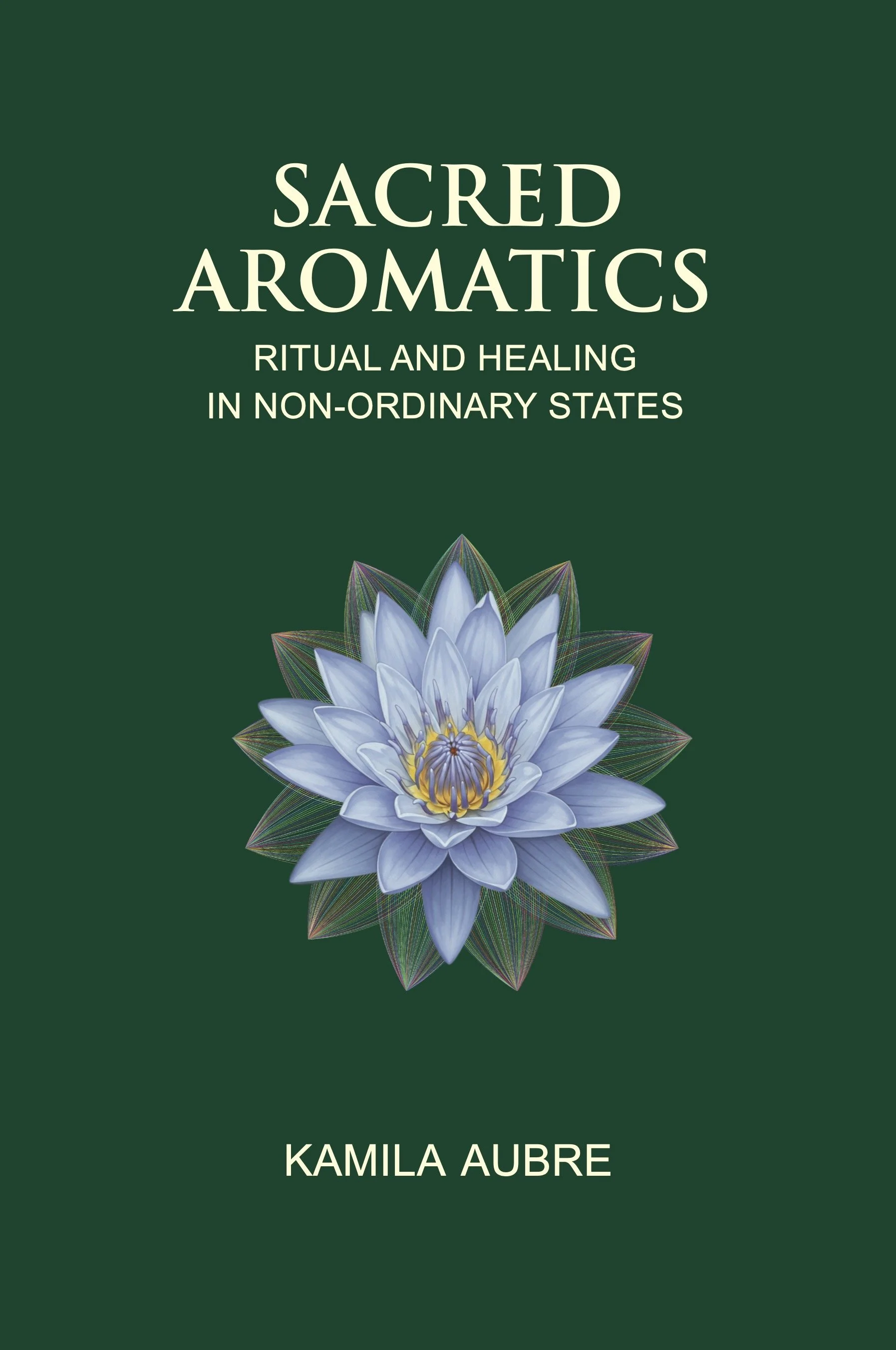
Sacred Aromatics
Ritual and Healing in Non-Ordinary States
Available at major online retailers worldwide.
An insightful guide to the relationship between entheogenic and aromatic botanicals, and their role in shaping consciousness and supporting healing.
This unique and exciting book presents a comprehensive guide to the use of powerful aromatic plants. With particular focus on their under-discussed role in sacred rituals and altered states of consciousness, Sacred Aromatics illuminates the olfactory dimension: how scent has historically functioned as a powerful catalyst for spiritual experience, emotional grounding, and therapeutic integration.
Drawing from ethnobotany, anthropology, natural perfumery, and psycho-aromatherapy, the first section of the book presents theoretical and practical foundations. It explores the cultural history of aromatic use, distinctions between indigenous and Western traditions, and how scent may interact with perception, mood, and altered states. Also introduced are methods of preparation and application, ethical sourcing, and safety considerations, alongside practical frameworks for ritual and symbolic use. Special attention is given to therapeutic support and integration, demonstrating how aromatics can act as anchors, bridges, or subtle modulators in altered states and spiritual contexts.
The second part of the book presents an A-Z materia medica of the plants commonly used in this practice, providing detailed information on botanical identity, ritual and historical use, aromatic and psychoactive properties, safety guidelines, and modern relevance.
Designed for a diverse readership—psychedelic facilitators, herbalists, spiritual seekers, aromatherapists, and scholars—Sacred Aromatics is an essential and timely contribution to the evolving field of plant medicine, reviving ancient practices for contemporary healing and spiritual work.
Book Details
Publisher : Aeon Books
Published : September 2026
Cover : Paperback
Pages : 276
Size : 152mm(w) x 229mm(h)
Catalogue No : 95444
ISBN 13 : 9781801522540
“This book is a wonderful merging of the spiritual and the scientific. Such integration is challenging but Kamila Aubre succeeds, making the text a highly refreshing read. I’m delighted to see that she has taken on board the message of safety, which is important for any use of essential oils, and yet it is uncommon when writing about their spiritual properties. Most essential oils are not pharmacologically psychoactive, but they can still influence our state of mind, especially when linked to meditation and ritual. The emerging field of aromapsychology is perhaps a different aspect of this, but in the ritualistic context of a therapy session. It has always fascinated me how ‘essential oil’ derives from ‘quintessence’ – the fifth element, often called ether, being the most subtle, and therefore the one that connects us most directly with the divine. In some European languages, essential oils are “ethereal oils”. Thank you, Kamila, for bringing me back to this place, but with a new context.”
- Robert Tisserand, author of Essential Oil Safety: A Guide for Health Care Professionals
"Working with non-ordinary states is both science and art — it depends on knowledge, but also on a sensitivity to the invisible threads that hold a session together, and scent is one of them. I have incorporated aromatics into my facilitation work for years, guided mostly by intuition rather than formal understanding, and Kamila Aubre’s work finally gives depth, context, and language to a dimension of practice that has long deserved more attention. Aubre invites us into the world of sacred scent, where fragrance and subtle perception become supports for deeper unfolding. Sacred Aromatics beautifully expands our understanding of how carefully chosen aromas can enhance therapeutic and ceremonial spaces.”
- Marc Aixalà, author of Psychedelic Integration: Psychotherapy for Non-Ordinary States of Consciousness
“With the advent of the industrial era, a profound shift occurred in the role of perfumes. As they drifted away from their roots in nature and became democratized through the emergence of synthetic molecules, the sacred, prophylactic, healing, and sometimes even magical functions they had carried since time immemorial gradually disappeared.
In recent times, however, there has been a renewed interest in olfaction, revitalized thanks to the work of historians, anthropologists, philosophers, and, more recently, scientists exploring the connections between the sense of smell and the areas of the brain involved in emotion and memory. At the same time, the ancient functions of perfumes are being rediscovered, particularly with the rise of scientific aromatherapy initiated in the 20th century by the chemist-perfumer René Maurice Gattefossé and the surgeon Jean Valnet. The remarkable powers of essential oils, capable of penetrating the skin, entering the bloodstream, and reaching the organs of the human body, are now increasingly used in hospitals and care homes.
It is within this promising movement of modern reappropriation of territories long abandoned by perfumery that we find the research of Kamila Aubre, whose work explores the impact of natural aromatics on sensory and psychic activity.”
- Annick Le Guérer, author of Scent: The Mysterious and Essential Powers of Smell
"Sacred Aromatics: Ritual, Healing, and Consciousness in Non-Ordinary States is a rare and luminous treasure. Kamila Aubre has created the shamanic companion I’ve been waiting for—an elegant, deeply researched guide to how aromas, botanicals, and essential oils can shape consciousness, transform ritual, and enhance visionary experience. This remarkable volume fills a long-neglected gap in entheogenic literature. With clarity, beauty, and scholarly depth, Aubre maps the subtle yet profound ways that scent influences psychology, neurochemistry, and the spiritual imagination. She catalogues sacred and psychoactive aromatic allies with exquisite care, weaving together ancient ritual practice, modern therapeutic insight, and the experiential wisdom of a seasoned practitioner. More than an encyclopedic compendium, this book is an initiatory guide—an indispensable companion for psychonautic exploration, ceremonial work, integrative healing, and anyone seeking to deepen their relationship with the plant world. Most highly recommended.”
- David Jay Brown, author of Dreaming Wide Awake and The Illustrated Field Guide to DMT Entities